
UpStArt – Colors to Die For
+ By Terese Schlachter
Cloth has been woven for millenia. The earliest examples of two-needle knitting go back to medieval times. Earlier exmaples may have existed and disintigrated with time. Perhaps prior to 300 AD someone picked up wooden sticks or bones and artfully knotted wool together to make garments. Not surprisingly, the practice of knitting caught fire in colder climates, especially in places such as Iceland, where it was first proven that behind every successful Viking was a woman creating a textile he could wear and sell, thereby exerting his influence across the North Atlantic. Knitting was eventually brought to America by Spanish colonists, but it wasn’t until the 1940s that knitting was really popularized, mostly due to World War I and again in World War II, when women were encouraged to “Knit Your Bit” to keep the nation’s service members warm. A few wars and even more spun yarns later, we find knitter, crocheter, weaver, and dyer Lyla Lawless making quite a mess in her bathtub.
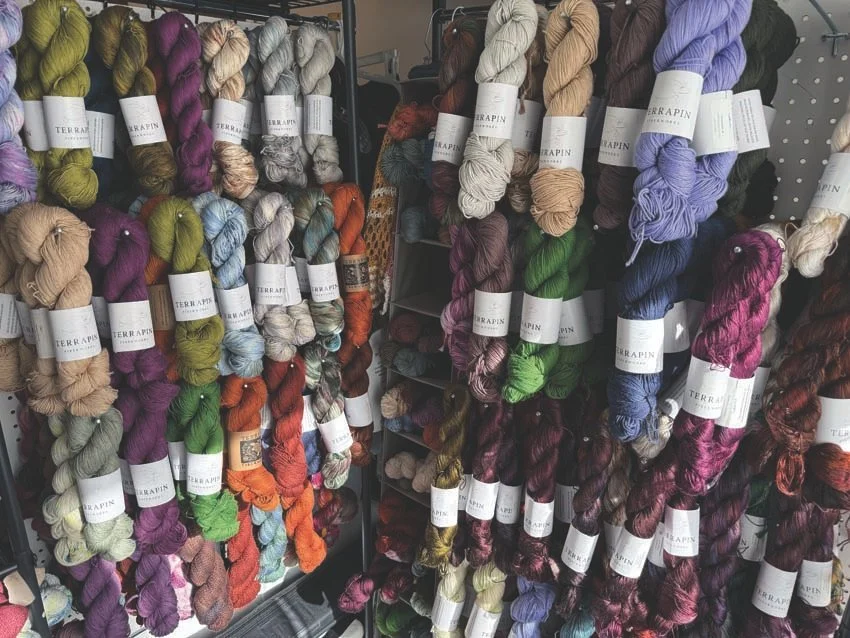
“It was a pandemic thing,” recalls Lawless, now owner of Terrapin Fiberworks, a craft yarn store located in the Annapolis Arts District. “We all got stuck at home, and we needed something we could do on our own, so a lot of people picked up knitting and crocheting.” Needlework became especially popular for millennials, and 32-year-old Lawless is among them. She says that the quiet rhythm of stitching was calming through a time heaving with anxiety. “And I love that feeling of satisfaction,” she says. “In the end, I’ve achieved something.” Life on the internet provided opportunities to connect with others regarding her work and her wares. Richly hued yarns for sale online often caught her eye, but the prices made her breath catch. She began to wonder if she could dye her own yarn. Which brings us to the bath.